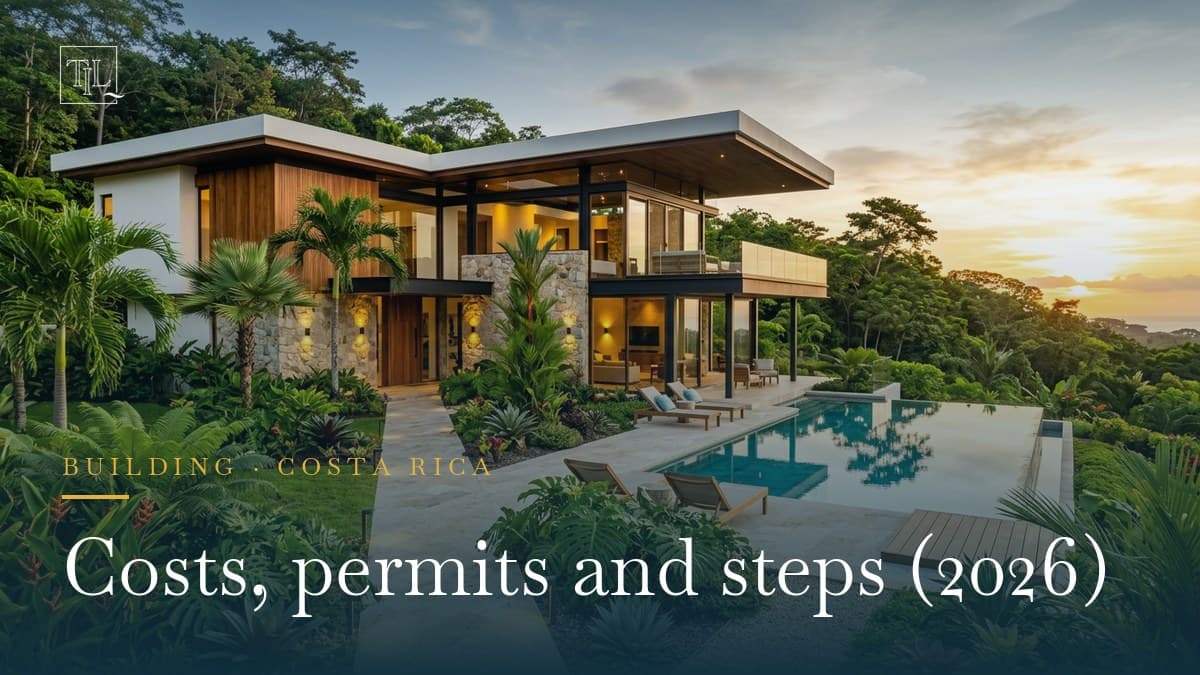
“What if we built instead?” The question almost always comes up after the third viewing, when no house ticks every box. Building in Costa Rica is entirely possible for a foreigner, with the same rights as a Costa Rican. But the price per square meter is only part of the budget, and the timeline is measured in years, not months.
Here is what a build really costs in 2026, which permits you need and in what order, and the question to ask before anything else: should you actually build?
1. How much does construction cost per square meter in 2026?
There is no official price list: the Colegio Federado de Ingenieros y de Arquitectos (CFIA), which registers every project, states that it has no cost-per-square-meter table and that each project is appraised on its own finishes. Figures published by industry professionals nonetheless converge:
| Finish level | Indicative construction cost |
|---|---|
| Standard | $850 to $1,100 per m² (≈ $79 to $102 per sq ft) |
| High-end | $1,200 to $1,800 per m² (≈ $111 to $167 per sq ft) |
| Custom luxury | from $2,000 per m² (≈ $186 per sq ft) |
Another estimate published in July 2026 puts construction alone at $1,028 to $2,050 per m², and the full project — design, permits and a contingency margin included — at $1,204 to $2,606 per m². On the coast, the trend is upward: construction costs in Guanacaste rose by nearly 12% in 2025.
A worked example
A 150 m² (≈ 1,615 sq ft) home with high-end finishes at $1,300 per m²:
| Item | Amount |
|---|---|
| Construction (150 m² × $1,300) | $195,000 |
| Architect and engineer fees (≈ 8%, see below) | $15,600 |
| CFIA fee and municipal construction tax (≈ 1.27%) | ≈ $2,500 |
| Soil study | $2,000 to $4,000 |
| Contingency (10 to 15%) | $19,500 to $29,250 |
| Total, excluding land, pool and utility connections | ≈ $235,000 to $246,000 |
In other words, budgeting 20 to 25% above the bare construction price is a reasonable starting point, not excessive caution.
2. Professional fees: a legal minimum set by the government
In Costa Rica, house plans must be signed by an architect or engineer registered with the CFIA — it is not optional. Their fees follow a schedule whose percentages are legal minimums: a professional may charge more, never less.
| Service | Minimum fee |
|---|---|
| Preliminary design | 1% of the estimated value |
| Construction drawings and specifications | 4% |
| Inspection (when a contractor builds for you) | 3% of the final value |
| Technical direction (when you build “by administration”) | 5% of the final value |
For a home built by a general contractor, that comes to about 8% — preliminary design, drawings and inspection. Be wary of a much lower quote: either a service is missing, or it will be billed later.
3. Permits, in order
Before any drawing, four documents tell you whether the project is possible: the land-use certificate (uso de suelo) issued by the municipality, the water availability letter from the local ASADA or AyA, power availability (ICE or, in much of Guanacaste, the local cooperative), and the setbacks from roads, rivers or power lines. No water, no permit: we cover this check in Buying land in Costa Rica: what to check before you sign.
The soil study ($2,000 to $4,000) determines the foundations. The drawings — architecture, structure, electrical, plumbing — are prepared by the registered professional in line with the Costa Rican Seismic Code: the country sits in an active seismic zone, and this is not a formality.
SETENA, the environmental authority, must sign off. For a single-family home the process is often simplified, or even waived depending on the area. In a sensitive zone — near a protected area or a river, on a steep slope — it can become a full study with its own cost and timeline.
The drawings are filed on the CFIA’s digital platform (APC). The CFIA charges a fee of 0.265% of the estimated value of the work.
The municipality reviews the file, often through the same platform, and charges a construction tax of 1% of the estimated value. Timelines depend heavily on the municipality and on how complete the file is: allow several weeks to a few months.
Before breaking ground, an INS occupational risk policy (póliza de riesgos del trabajo) must cover everyone working on site. It is mandatory; a site without it exposes the owner personally if an accident happens.
Once permits are in hand, construction itself usually takes 12 to 18 months for a standard home, longer for a custom project. From finding the lot to getting the keys, two years is nothing unusual.
4. Building from abroad: where projects go wrong
Most bad experiences come neither from permits nor from the price per square meter, but from oversight. Four rules prevent most of the trouble:
- A written contract, in Spanish and in your language, stating the price, what it includes, the schedule and what happens in case of delay.
- Milestone payments released against verified progress — foundations, structure, roof, finishes — never ahead of the work.
- A professional who represents you, independent from the contractor: that is the whole point of the inspection service.
- Every change priced in writing before it is made. “Small changes” requested by text message are the number-one cause of overruns.
5. Build or buy an existing home?
| Build | Buy an existing home | |
|---|---|---|
| Timeline | 18 to 24 months, including the land search | 2 to 3 months |
| Budget | Estimated, with overrun risk | Known on the day you make the offer |
| Fit with your plans | Complete | A compromise |
| Presence required | High, or a trusted representative | A few days to view and sign |
| What you see before buying | Drawings | The house, its airflow, its neighbors, its condition after a rainy season |
6. Special cases
On the beach
Within 200 meters of the high-tide line, the first 50 are public and cannot be built on; the next 150 fall under a municipal concession rather than ownership, with a zoning plan and rules of their own. It is all explained in Maritime concession vs. titled property in Costa Rica.
Building in phases
It is possible and common: a first house, then an extension or a second building. Each phase needs its own permits. Plan for it from the first drawings so that utilities and access are sized accordingly.
Frequently asked questions
Can a foreigner build a house in Costa Rica?
Yes. A foreigner can buy titled land and build on it with the same rights as a Costa Rican, without being a resident. The only differences concern beachfront concessions, which have their own rules.
Can you build without a permit?
No. Unpermitted construction risks a stop-work order, fines and, in serious cases, demolition. Above all, it becomes very hard to insure, finance and resell: a serious buyer and their attorney will check that every built square meter matches a permit.
How long does it take overall?
Several weeks to a few months for permits, then 12 to 18 months of construction for a standard home. Including the land search and design, a two-year project is common.
Are container or prefab homes allowed?
Yes, provided they follow the same process: drawings signed by a registered professional, compliance with the Seismic Code, a municipal permit. The building method does not exempt you from any step.
Is a design-build firm the better option?
It is often simpler from abroad, as long as you keep an independent professional for inspection. The company doing the building cannot be the one checking its own work.