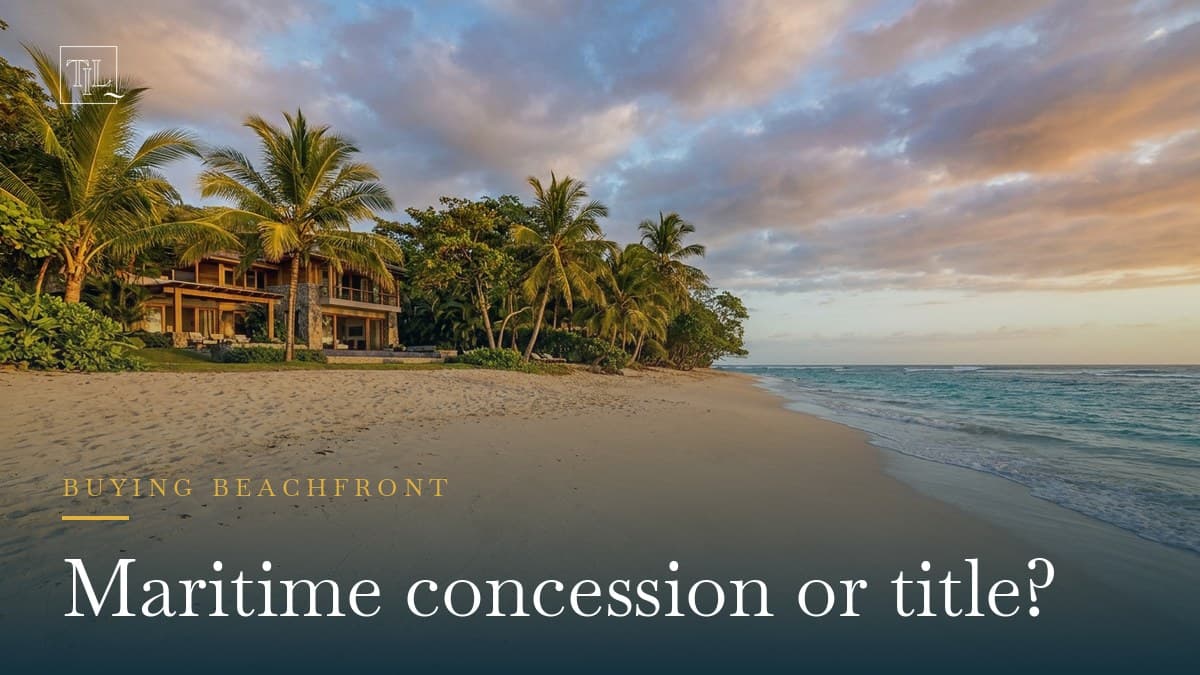
You dream of a beachfront villa in Samara, Nosara or elsewhere on the Nicoya Peninsula. Before you sign, one question must take priority over all the others: is this land a titled property that you will fully own, or merely a beachfront concession, that is, a temporary right of use granted by the municipality? Confusing the two is the number-one trap when buying beachfront property in Costa Rica. Rest assured: it is easily avoided, provided you know what to check.
The zona marítimo terrestre: the rule that governs the entire coastline
In Costa Rica, the coastal strip is governed by a specific law, Ley 6043 on the zona marítimo terrestre (ZMT). It defines a strip 200 metres wide, measured from the ordinary high-tide line, all along the Pacific and Atlantic (Caribbean) coasts. This zone belongs to the State’s public domain: in principle, it is not sold or bought like an ordinary plot of land.
Understanding how this strip is divided is the key to buying beachfront property in Costa Rica with complete peace of mind. It splits into three parts that are very different in legal terms.
The three coastal strips of Costa Rica
| Strip | Distance from the high-tide line | Legal status | What you can do there |
|---|---|---|---|
| Public zone | 0 to 50 m | Public domain, cannot be owned | Nothing on a private basis: public use, free passage, land cannot be built on |
| Restricted zone | 50 to 200 m | Can be granted as a concession by the municipality | Obtain a concession (right of use), subject to conditions |
| Outside the ZMT | Beyond 200 m | Private titled ownership possible | Buy in full ownership, like a national |
The first 50 metres: untouchable
The first 50 metres, measured from the high-tide line, form the public zone. They are intended for everyone’s use and for free passage, and remain strictly off-limits to construction. Above all, they cannot be owned under any title whatsoever: no one can take them over, whether by sale or by concession. So be wary of any offer promising you a lot “on the sand”: it is legally impossible.
The next 150 metres: the concession zone
The next 150 metres (from 50 to 200 m) make up the restricted zone. It may be the subject of a concession granted by the competent municipality. In areas declared as tourist zones, this concession also requires the approval of the Costa Rican Tourism Board (ICT). This is where the most common—and most costly—confusion arises.
A concession is not ownership: what you are really buying
A maritime concession in Costa Rica is not full ownership (fee simple). It is a right of use for a fixed term—typically 5 to 20 years, renewable—granted by the municipality. It is not recorded in the land registry like an ordinary title of ownership: it follows a distinct legal regime.
In practical terms, the concession holder enjoys the use of the land and may, depending on the conditions of the regulatory plan, build on it, but does not “own” the ground in the full sense. When the term expires, the concession must be renewed. This status also entails significant restrictions for foreign buyers:
- A foreigner must have resided in Costa Rica for at least 5 years to be able to hold a concession.
- A company holding a concession cannot be more than 50% foreign-owned.
These rules often surprise international buyers who thought they could freely acquire a “beachfront” property. Hence the crucial importance of checking the legal status before making any commitment.
The good news: many coastal lots are titled
Here is what people often forget to point out: not all beachfront is subject to the concession regime. Many coastal lots are in fact titled properties—that is, held in full ownership—because they lie outside the zona marítimo terrestre, or because they benefit from exceptions that predate the law.
These properties are bought without the restrictions specific to concessions. And this is a fundamentally reassuring point: on a titled property in Costa Rica, a foreigner has exactly the same rights as a national. You can buy, hold and resell in your own name, with no residency requirement and no ownership cap.
In other words, the real question is not “can I buy beachfront?” but “is this specific property titled or held under concession?”. The answer changes everything: price, financing, legal security and future resale.
Never rely on someone’s word or on a listing. The status is verified in black and white, before the purchase, by cross-checking three sources:
- The Registro Nacional: confirms the existence of a title of ownership in the seller’s name.
- The plano catastrado (cadastral survey map): identifies the parcel, its boundaries and its location relative to the ZMT.
- The municipality: indicates whether the land falls within the zona marítimo terrestre, whether a regulatory plan exists and, where applicable, the exact status of the concession.
Always have this verification carried out with the support of an independent Costa Rican lawyer.
FAQ: buying beachfront property in Costa Rica
Can foreigners buy beachfront property?
Yes, provided you distinguish between the two cases. On a titled property (outside the ZMT or under a prior exception), a foreigner has the same rights as a national: purchase in full ownership, with no restriction. On a concession in the restricted zone, however, you must have resided in the country for at least 5 years, and a concession-holding company cannot be more than 50% foreign-owned.
Is a concession worthless?
No. A concession can be a sound investment, provided you understand its nature: a right of use for a fixed term (5 to 20 years, renewable), subject to conditions and not equivalent to full ownership. Price, financing and resale must be assessed accordingly, and not as if it were an ordinary title.
How can I tell whether land is titled or held under concession?
By cross-checking three sources: the Registro Nacional (existence of a title), the plano catastrado (location relative to the 200 m of the zona marítimo terrestre) and the municipality (applicable regime, regulatory plan, any concession). Carried out before signing, they remove all ambiguity.
Can you own the first 50 metres of beach?
No, never. The first 50 metres form a public zone: off-limits to construction and impossible to own under any title whatsoever. No sale or concession is possible on this strip, which is reserved for everyone’s use and for free passage.
This article is intended for information only and does not constitute legal advice. Costa Rican regulations (Ley 6043 on the zona marítimo terrestre, municipal regulatory plans, ICT requirements) change and must be assessed case by case: always have a property’s titled or concession status verified by a Costa Rican lawyer before making any commitment. At Tendance Immo Latina, we systematically check this status for every property we offer. Discover our selection of properties for sale in Samara (Guanacaste) or talk with our team via our contact page.