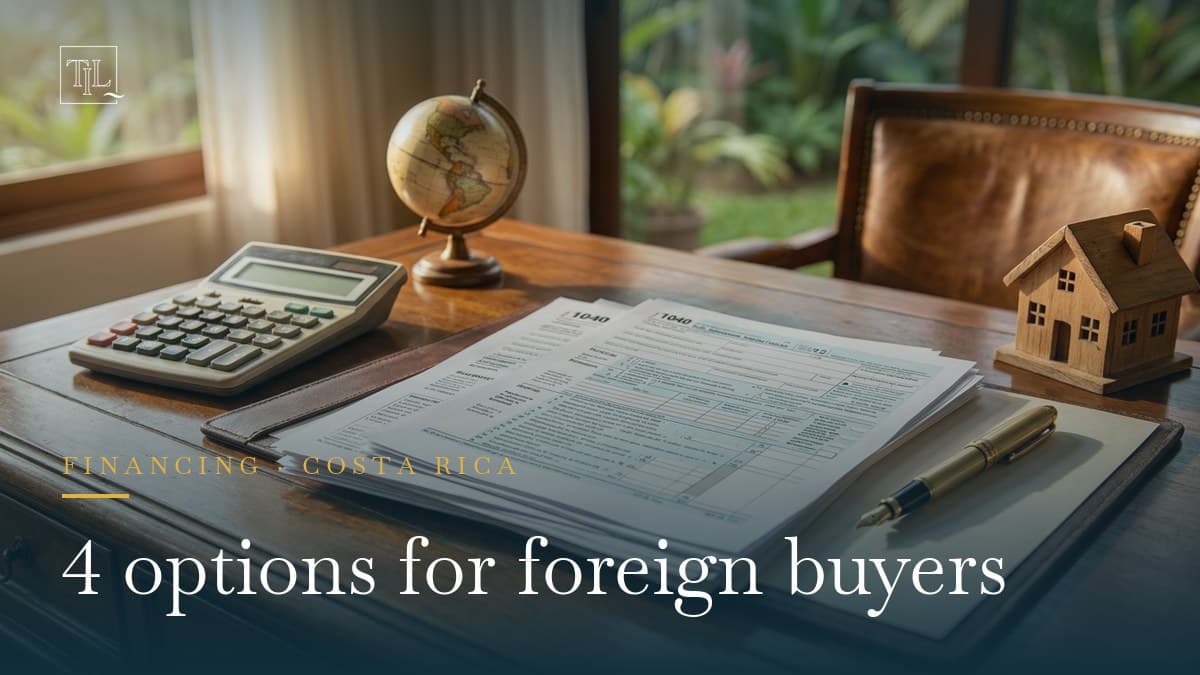
“Can I get a mortgage in Costa Rica?” It is one of the first questions buyers ask us, and the honest answer fits in one sentence: yes, it is possible, but rarely on the terms a North American or European buyer is used to. Here are the four routes actually used in 2026, with their rates, down payments and timelines — and the one that is almost always cheapest.
The starting point: a market that mostly pays cash
In Costa Rica, most purchases by foreigners close without a local loan. That is no accident: the Costa Rican banking system was not designed to finance non-residents, and its terms reflect it. Knowing this before you start saves a lot of disappointment. It does not mean you need the full amount in cash: several solutions exist, but they rarely go through a local bank branch.
Option 1 — A loan from a Costa Rican bank
Several institutions lend to foreigners, including BAC, Banco Promerica, Banco de Costa Rica (BCR), Banco BCT and Banco Lafise. Typical terms in 2026:
| Criterion | Order of magnitude in 2026 |
|---|---|
| USD interest rate | about 7.5% to 10%, for a resident borrower or one with local income |
| Loan-to-value | 60% to 70% of the appraised value at best |
| Down payment | 30% to 50% of the price; the upper end for non-residents |
| Term | up to 20 to 25 years depending on the lender |
| Time to close | six weeks to several months |
| Loan closing costs | about 3% to 4% of the loan in total, including: mortgage registration (0.25% plus stamps), notary fees (0.5% to 1.25%), appraisal ($500 to $1,200) |
Banks also generally require life insurance on the borrower and property insurance for the life of the loan. And one point many buyers discover too late: a property in the maritime concession zone is generally not bankable, since it is not full ownership. We explain why in Maritime concession vs. titled property.
Two other realities to plan for: the paperwork — translated and often apostilled proof of income, bank history, a credit report — and the fact that everything gets much easier once you are a resident with income or a banking history in Costa Rica.
Option 2 — Seller financing
Among foreign buyers who do not pay cash, this is the route used most — and the one least known outside the region. The principle: the seller lends to you. You pay a down payment at closing, then monthly installments to the seller, who is secured by a mortgage registered in their favor at the National Registry.
| Advantages | Watch-outs |
|---|---|
| No bank application | High down payment, often 30% to 50% |
| Fast closing, in one to two weeks | Short term, often 3 to 5 years, with a large balloon payment |
| Negotiated rate, often around 7% to 9% | You must be able to pay or refinance the balloon when it falls due |
| Negotiated together with the price, in the same offer | The legal drafting must be flawless |
Option 3 — Private lenders
Private lenders move fast — sometimes in two or three weeks — but at a price: 10% to 15%, over short terms of 2 to 5 years, with a down payment of around 50%. It is a bridge solution, to seize an opportunity while you sell another property or line up cheaper financing. Not a way to own long term.
Option 4 — Financing from home
When it is available, this is the cheapest route. Three common forms:
- A home equity line of credit (HELOC) or a cash-out refinance on property you already own, at your home country’s rates, secured by an asset your bank knows. You arrive in Costa Rica as a cash buyer — the strongest negotiating position.
- A securities-based loan, if you hold investments: some banks lend against a portfolio without forcing you to sell.
- Existing savings. Costa Rica has no exchange controls: funds come in and, when the time comes, go out freely. We explain how in Repatriating money from Costa Rica.
The four routes side by side
| Local bank | Seller | Private lender | From home | |
|---|---|---|---|---|
| Cost | 7.5% to 10% | Negotiated, often 7% to 9% | 10% to 15% | Usually the lowest |
| Down payment | 30% to 50% | 30% to 50% | ≈ 50% | Depends on your bank |
| Time to close | 6 weeks to several months | 1 to 2 weeks | 2 to 3 weeks | Depends on your bank |
| Term | Up to 20-25 years | 3 to 5 years | 2 to 5 years | Depends on your bank |
| Negotiating position on price | Average | Weak | Average | Strong (cash buyer) |
Frequently asked questions
Do I need to be a resident to get a mortgage in Costa Rica?
No, but it changes a lot. Non-residents generally get a lower loan-to-value, must provide more documentation, and some banks reserve their best terms for clients with income or history in the country.
Can I finance land or new construction?
It is much harder than for an existing home: banks lend little on raw land, and construction loans for non-residents remain rare. Seller financing or funds from home are the realistic routes here. If you are thinking of building, see our guide Building a house in Costa Rica.
Borrow in dollars or in colones?
If your income is in Canadian dollars or euros, both expose you to currency risk. Borrowing in colones adds a second one, the local currency, which has appreciated sharply since 2022. For a foreign buyer, the US dollar remains the reference currency of the real estate market.
Can the seller take the property back if I don’t pay?
Yes, that is exactly what the mortgage registered in their favor is for: in case of default, they can foreclose. That is why the schedule, the balloon payment and the default procedure must be negotiated and written down before signing.