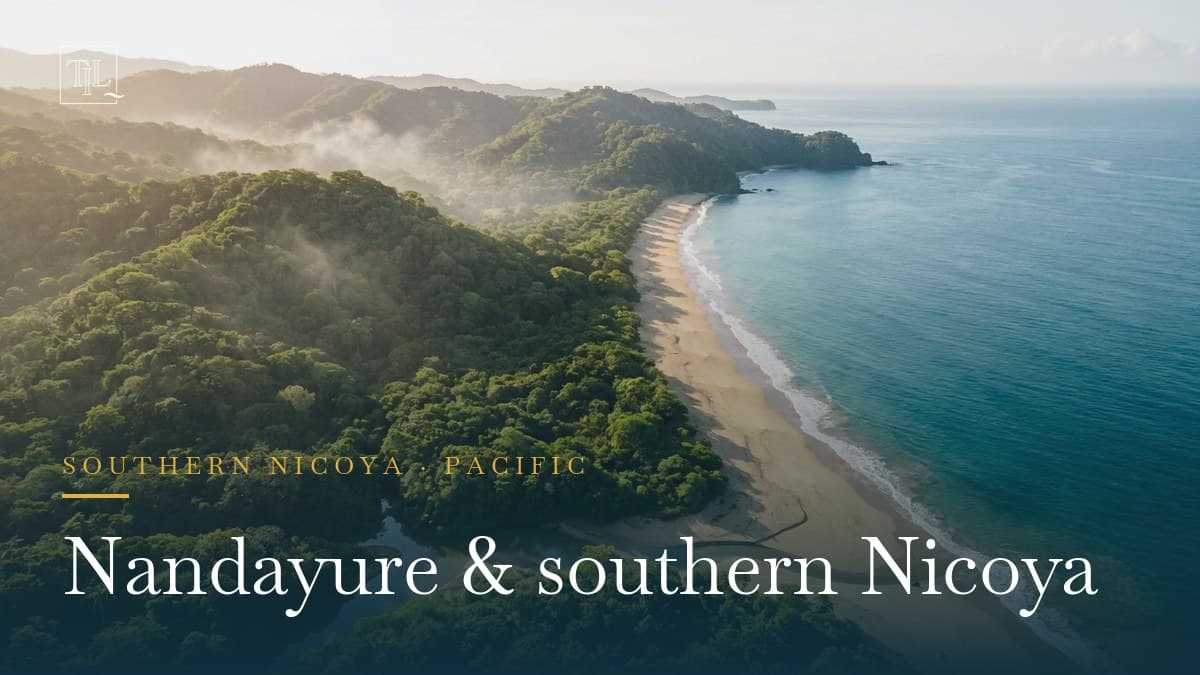
Between the Río Ora and the Río Bongo, the canton of Nandayure unfurls a string of beaches that mass tourism has not yet reached. For anyone dreaming of buying beachfront land or a house in Costa Rica without matching the prices of Tamarindo or Nosara, it is probably one of the last hidden gems in Guanacaste. On one condition, which we own up to in all honesty: accepting the dirt road, the 4×4 and a measure of patience. Here is our expert read on real estate in Nandayure.
Where is Nandayure?
Nandayure is a canton in the province of Guanacaste, with Carmona as its administrative seat. Very rural, it has around 11,000 inhabitants and cuts across the center of the Nicoya Peninsula to the Pacific coast, between the Río Ora to the north and the Río Bongo to the south. Administratively, it is divided into six districts: Carmona, Santa Rita, Zapotal, San Pablo, Porvenir and Bejuco.
This location, away from the major tourist routes, explains both the tranquility of the place and the relative difficulty of access. Two sides of the same coin that every buyer should keep in mind: what makes Nandayure still affordable is precisely what makes it demanding.
Secluded beaches, from north to south
The canton’s coastline lines up beaches that are still wild, often nearly deserted. From north to south, you come across:
- Playa Camaronal
- Playa Islita (Punta Islita)
- Playa Corozalito
- Playa Bejuco
- Playa Coyote, which includes Playa San Miguel and Costa de Oro
- Playa Caletas
- Playa Pencal
The living heart of this coastline is the village of San Francisco de Coyote, the convergence point for the area’s services. This is where most of the offering is concentrated when you are looking to buy land in Playa Coyote or San Miguel, Costa Rica.
An important marker so you don’t mix up cantons: Playa Carrillo is often billed as the “northern gateway” to the area, but it actually lies on the Sámara / Nicoya side (canton of Hojancha) and not in Nandayure. A distinction that matters when you compare property listings.
A preserved coast, in the heart of the “Blue Zone”
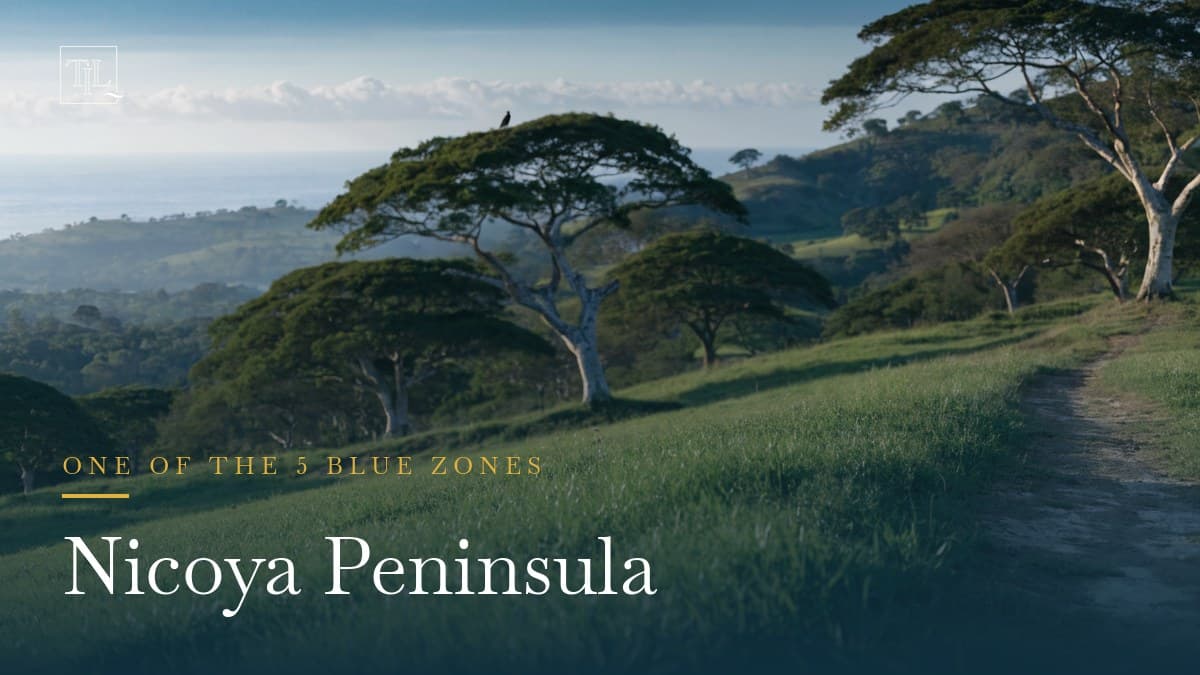
Nandayure’s character comes down to one word: preservation. The coast is rural, secluded, still largely spared from concrete. Nature here is intact, with turtle-nesting sites and conservation areas at Camaronal and Corozalito. The canton also belongs to the famous Nicoya “Blue Zone”, one of the few regions in the world where longevity is statistically remarkable.
Far less developed than northern Guanacaste (Tamarindo) or Nosara, the area has stayed off the mass-tourism radar. For a buyer seeking peace and nature, that is a major asset. The hills of the hinterland also offer cooler air at altitude, a welcome thing at these latitudes.
One technical point never to overlook: we are in a seismic zone. A magnitude 7.6 earthquake struck the Nicoya Peninsula in 2012, with a nearby epicenter. Any construction must therefore strictly comply with Costa Rican seismic building standards — a criterion to verify for a new project as much as for an existing house.
Access: the real issue, to know above all else
Let’s be direct, because this is the number-one point to watch. You don’t arrive in Nandayure by chance, and that is precisely what protects the area.
On the air front, you have to be clear-eyed. The Punta Islita airfield is private and does not handle scheduled commercial flights; the Carrillo airstrip is closed. The nearest scheduled domestic airport is therefore the one in Nosara.
To put distances in perspective from Playa Coyote: reckon on about 137 km and 2.5 hours from Liberia (LIR), and about 236 km and 5 hours from San José. The road is paved for roughly 60%; the rest is on dirt track. Nothing insurmountable for those who are equipped and forewarned, but anything but trivial.
The Nandayure real estate market in 2026
This is where the promise of “affordable beachfront real estate in Nicoya” makes sense. Under-development and difficulty of access mean the area is not yet “priced” like its neighbors. Here are some ballpark figures (asking prices, “from” or “around,” variable by nature):
| Property type | Indicative range | Notes |
|---|---|---|
| Village / inland lot | from ~$60,000 | Small parcel, no ocean view |
| Ocean-view / near-beach lot (0.8–1.6 ha) | ~$150,000 to $650,000 | Depending on view, size and distance to the beach |
| Large finca | ~$200,000 to $1.8M | Price according to size |
| Entry-level house (cabin) | from ~$130,000 | Simple construction |
| Ocean-view house (core of the market) | ~$350,000 to $500,000 | The most active segment |
| High-end / titled beachfront | ~$1M to $1.7M and above | Scarcity of titled seafront land |
Two useful reflexes. First, negotiation is part of the local culture: in Costa Rica, properties often sell 6 to 12% below the initial asking price. Second, bear in mind that the discreet presence of a luxury anchor — the Hotel Punta Islita (Autograph Collection / Marriott) — “anchors” the area and reassures on its potential, without over-developing it. A rare balance.
Want to see what’s available today? Browse our selection of properties for sale in Nandayure.
Services and points to watch
Services are concentrated in San Francisco de Coyote: supermarkets, ICE (electricity and telecommunications), a high school, a gas station, and even a bus connection to San José. That is reassuring. But beware: on isolated lots, water, electricity and internet coverage is uneven. You have to check lot by lot, never assuming that a parcel is connected.
The maritime concession (ZMT), key to the seafront
Two other points deserve your attention. Water first: any well or water intake requires a water concession issued by MINAE — something to secure upfront for an unconnected lot. Seismic risk next, already mentioned, which requires code-compliant foundations and structure.
The strengths, in summary
Still-affordable prices, preserved nature and rare tranquility, membership of the Blue Zone, cooler hills at altitude. Good news for international buyers: on titled property, foreigners have the same rights as Costa Ricans. Unlike the ZMT, there is therefore no nationality restriction to fear.
Frequently asked questions
Why is it cheaper than in Nosara or Tamarindo?
Essentially because of under-development and access. Nandayure has stayed rural, away from the main routes and mass tourism, with partly unpaved roads. The market here is therefore not yet “priced” like the neighboring resorts. It is exactly this gap that creates the opportunity: today you pay the price of an area that development has not yet caught up with.
How do you get to the area?
By 4×4 vehicle, which is essential. From Playa Coyote, reckon on about 137 km (2.5 hours) from Liberia and 236 km (5 hours) from San José, on a road paved for about 60%, the rest on dirt track — sometimes with a river to ford. The Punta Islita airfield is private, with no scheduled commercial flights; the nearest scheduled domestic airport is the one in Nosara. Plan your visit taking into account the rainy season, which makes certain stretches impassable.
Can a foreigner buy on the seafront?
Yes, but the nuance is crucial. On titled property, a foreigner has the same rights as a national. However, the strip of the Maritime Terrestrial Zone (the 150 meters under concession after the 50 public meters) falls under a lease subject to restrictions for foreigners. Hence the appeal — and the scarcity — of titled seafront lots.
Do you really have to build to seismic standards?
Absolutely. The Nicoya Peninsula is an active seismic zone — a magnitude 7.6 earthquake was recorded there in 2012, with a nearby epicenter. Any construction, new or renovated, must comply with Costa Rica’s seismic building standards. It is a point to verify systematically, including on an existing house.
Our expert conclusion
Nandayure and the south of the Nicoya Peninsula tick a rare box: that of a Pacific coast that is still affordable, preserved and authentic, at a stage where you can still buy before prices align with those of the rest of Guanacaste. The price of admission is access: dirt roads, fording, a 4×4 and a bit of logistics. For the well-advised and well-informed buyer, it is a modest price against the potential. Want to discuss it concretely, project in hand? Contact our team.
The prices, distances and information cited in this article are given for purely indicative purposes and represent ballpark figures for the year 2026, liable to vary according to the property, the views, the surface areas, the state of the titles and market conditions. They constitute neither an offer, nor an appraisal, nor legal or tax advice. The availability of utility connections (water, electricity, internet), the land status (titled property or concession in the Maritime Terrestrial Zone), water concessions (MINAE) and seismic compliance must be verified on a case-by-case basis, lot by lot, with a notary (abogado-notario) and the competent professionals. Tendance Immo Latina supports you through these checks.