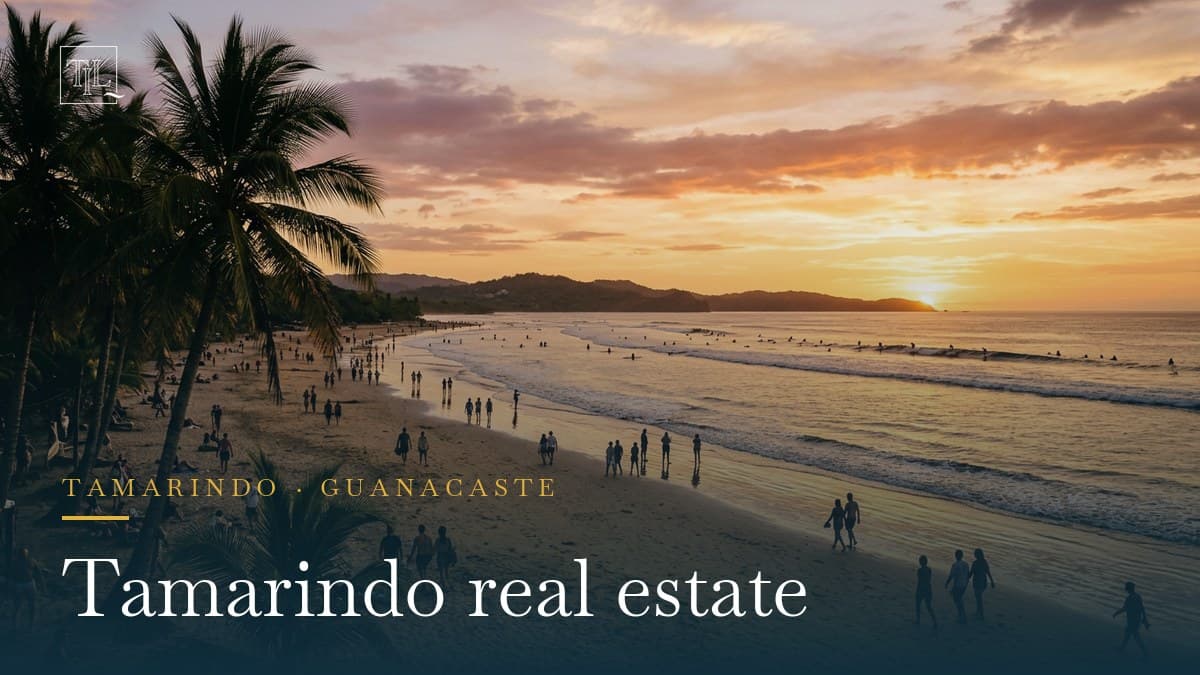
Tamarindo is arguably the best-known beach resort town in Costa Rica, and one of the country’s most dynamic real-estate markets. The nation’s surf capital — lively year-round, thoroughly international and served by paved roads all the way to Liberia airport — it attracts remote workers, rental investors and second-home buyers. But it is also one of the most expensive areas on the Pacific coast. Here, straight to the point, are the prices, the neighbourhoods and the points to watch when buying in Tamarindo in 2026.
Tamarindo, Guanacaste’s “Gold Coast”
Located in northern Guanacaste, in the canton of Santa Cruz, Tamarindo belongs to what is known as Costa Rica’s “Gold Coast”. It is THE country’s surf capital: a very touristy, lively resort town with a strong international presence — so much so that it has earned the affectionate nickname “Tamagringo”. You’ll find complete infrastructure, a genuine nightlife, a rare density of restaurants and shops, and even international schools along the Flamingo–Tamarindo corridor.
In other words, Tamarindo is anything but a sleepy village. It is a genuine living hub where you can settle without a car being essential day to day, find services in French and English, and rent out a property easily. This maturity has a downside: land here is among the most sought-after — and the most expensive — in the region.
Easy access from Liberia airport
One of Tamarindo’s great strengths is its accessibility. Liberia International Airport (LIR) is about 68 km away, roughly 1 hr 15 to 1 hr 30 by road (up to 2 hours at the peak of the year-end holidays). Above all, the road is fully paved: no dirt track to negotiate, unlike some destinations in the south of the Nicoya Peninsula. For a second home or a rental property, this ease of access is a strong selling point: it reassures buyers and future tenants alike.
Tamarindo property prices in 2026
Let’s be clear: Tamarindo is among the most expensive markets in Costa Rica. The figures below are asking prices, given as orders of magnitude (“from / around”). They vary enormously depending on proximity to the beach, the view, the condition of the property and whether it sits within a gated community. Treat them as benchmarks, not as fixed rates.
| Property type / Area | Indicative price range (2026) |
|---|---|
| Entry-level condo (Villareal, Santa Rosa, Huacas) | ~$180,000–$320,000 |
| Condo, market average | ~$465,000 |
| House, median price | ~$520,000 |
| House, average price | ~$820,000 |
| Luxury villa (Playa Langosta, Hacienda Pinilla) | ~$1.8M–$4.5M |
| Price per built square metre | ~$2,900–$3,400/m² |
In practice, the median house sits around $520,000, while the average climbs towards $820,000 — the gap is explained by a handful of high-end properties that pull the average up. On the apartment side, the average condo is around $465,000. A realistic entry point, meanwhile, is more like $180,000 to $320,000, often in the form of older condos in inland areas such as Villareal, Santa Rosa or Huacas.
The condo remains the simplest way into this market: easier to finance, manage and rent out than a detached house, particularly within a homeowners’ association that handles maintenance, security and sometimes rental management. For a first purchase or a rental investment, it is often the most pragmatic choice.
Good news for buyers: after the 2021-2023 boom, the market is rebalancing. Prices remain high, but negotiation is possible again, especially on properties that have been listed for several months. You can browse the properties for sale in Tamarindo to get a concrete sense of current price levels.
Tamarindo’s neighbourhoods and beaches: which to choose?
“Tamarindo” actually covers several beaches and areas with very different vibes. Choosing the right neighbourhood is probably the most decisive decision of your whole purchase.
Playa Tamarindo
The lively heart of the resort town: surf, shops, restaurants, nightlife. This is where short-term rentals work best, but also the busiest and noisiest area. Ideal if you’re after buzz and rental yield; less so if you dream of peace and quiet.
Playa Langosta
Just to the south, Langosta is a quieter, more upscale residential area. It is home to a good share of the market’s luxury villas. It’s the ideal compromise to stay a few minutes from Tamarindo’s bustle while sleeping in peace.
Playa Grande
To the north, Playa Grande is bordered by a sea-turtle reserve. The atmosphere is distinctly more natural and peaceful, with excellent surf and controlled development. A heartfelt choice for those who put the environment and calm above the buzz.
Hacienda Pinilla
A vast residential resort with a golf course, Hacienda Pinilla targets the high end, with security, services and manicured surroundings. As in Langosta, you’ll find villas in the $1.8M to $4.5M range.
Villareal, Huacas and Santa Rosa
These inland areas, set slightly back from the beach, concentrate the services and the entry-level stock. This is where most of the more affordable properties are found, around $180,000 to $320,000. Good ground for a sensible first investment.
• Short-term rentals / buzz: Playa Tamarindo.
• Calm and prestige, steps from the action: Playa Langosta.
• Nature, surf and tranquillity: Playa Grande.
• Secure high-end living with golf: Hacienda Pinilla.
• Controlled budget / first purchase: Villareal, Huacas, Santa Rosa.
Who is Tamarindo for?
The buyer profile is fairly clear: remote workers drawn by the connectivity and services, rental investors attracted by steady tourist demand year-round, and second-home buyers. In short, Tamarindo suits those who want amenities, buzz, quick airport access and a property that’s easy to rent out. If, on the contrary, you’re seeking a remote, wild retreat, other destinations on the Nicoya Peninsula will suit you better — which is precisely the subject of our Sámara, Nosara or Tamarindo comparison.
Points to watch before buying
Buying in Tamarindo calls for a few precautions. First, prices: they are among the highest in the country, which makes comparing properties and negotiating all the more important. Next, activity and noise vary widely from one area to another — if peace and quiet matter to you, head to Langosta or Grande rather than the centre. Finally, keep in mind that the rainy season runs from May to November: ideal for visiting in the green season and negotiating, but something to factor into your living or rental plans.
Good news, on the other hand, for international buyers: in Costa Rica, foreigners enjoy the same rights as nationals over titled property, and no residency is required to buy. The vast majority of the properties featured in this guide are titled — it is mainly the beachfront that calls for verification.
FAQ — Tamarindo real estate
Is Tamarindo expensive?
Yes, Tamarindo is among the most expensive markets in Costa Rica. The median house sits around $520,000 (average close to $820,000) and the price per built square metre is between $2,900 and $3,400. There are, however, more accessible entry points, around $180,000 to $320,000, on older condos in Villareal, Santa Rosa or Huacas.
Which neighbourhood should you choose in Tamarindo?
It depends on your goal. Playa Tamarindo for buzz and short-term rentals; Playa Langosta for calm and prestige a stone’s throw from the centre; Playa Grande for nature and tranquillity; Hacienda Pinilla for secure high-end living with golf; Villareal, Huacas and Santa Rosa for a controlled budget.
A condo or a house for a first purchase?
The condo is generally the simplest way in: easier to manage, secure and rent out, often within a homeowners’ association that handles maintenance. It’s the most pragmatic choice for a first investment or a seasonal rental.
Can a foreigner buy a villa in Tamarindo?
Yes. On titled property, foreigners have the same rights as Costa Ricans and do not need to be residents. The only caveat concerns the beachfront, where the maritime concession (ZMT) follows particular rules that must be checked before signing.
Want tailored support for your Tamarindo project? Contact our trilingual team: we’ll help you target the right area, decode the ownership statuses and negotiate at the right price.
The prices mentioned in this article are indicative orders of magnitude, based on 2026 asking prices and subject to significant variation depending on the property, the area, the view and market conditions. They constitute neither a valuation, nor investment advice, nor a contractual commitment. All information — in particular the ownership status (titled or maritime concession), the fees and the conditions applicable to foreigners — must be verified with qualified professionals (lawyer, notary, real-estate agent) before any purchase. Tendance Immo Latina cannot be held responsible for decisions made solely on the basis of this content.